

Glossary
- Ombudsman: A neutral person who listens to complaints and helps resolve disputes fairly.
- Ombudsman pronunciation: om-budz-man
- Banking ombudsman: An authority that resolves customer complaints against banks.
- RBI ombudsman: The banking ombudsman scheme run by the Reserve Bank of India.
- Insurance ombudsman: An authority that handles complaints related to insurance companies.
Ombudsman Meaning
The ombudsman meaning refers to a neutral and independent authority that helps people resolve complaints against organizations, businesses, or government departments. An ombudsman listens to both sides, investigates the issue, and suggests a fair solution.
In simple words, an ombudsman is someone you can approach when you feel you have been treated unfairly and normal complaint methods have not worked.
Official Ombudsman Definition
To define ombudsman, it is an official appointed to receive, examine, and resolve complaints made by individuals against institutions. The role focuses on fairness, transparency, and accountability. An ombudsman does not usually act like a court or judge. Instead, they investigate facts and recommend solutions that help fix problems without long legal battles.
What is an Ombudsman and Why Does it Exist?
If you’re wondering what is an ombudsman, the answer is simple: it exists to protect people from unfair treatment.
Ombudsmen were first introduced in Sweden and are now used in many countries across the world. Their main purpose is to ensure that powerful institutions do not misuse authority and that common people have a voice.
Who is Ombudsman Accountable To?
Many people ask who is ombudsman accountable to. An ombudsman usually works independently and is not controlled by the organization being investigated. This independence allows them to act fairly and without pressure.
They may report findings to the government, regulators, or senior management, depending on the sector.
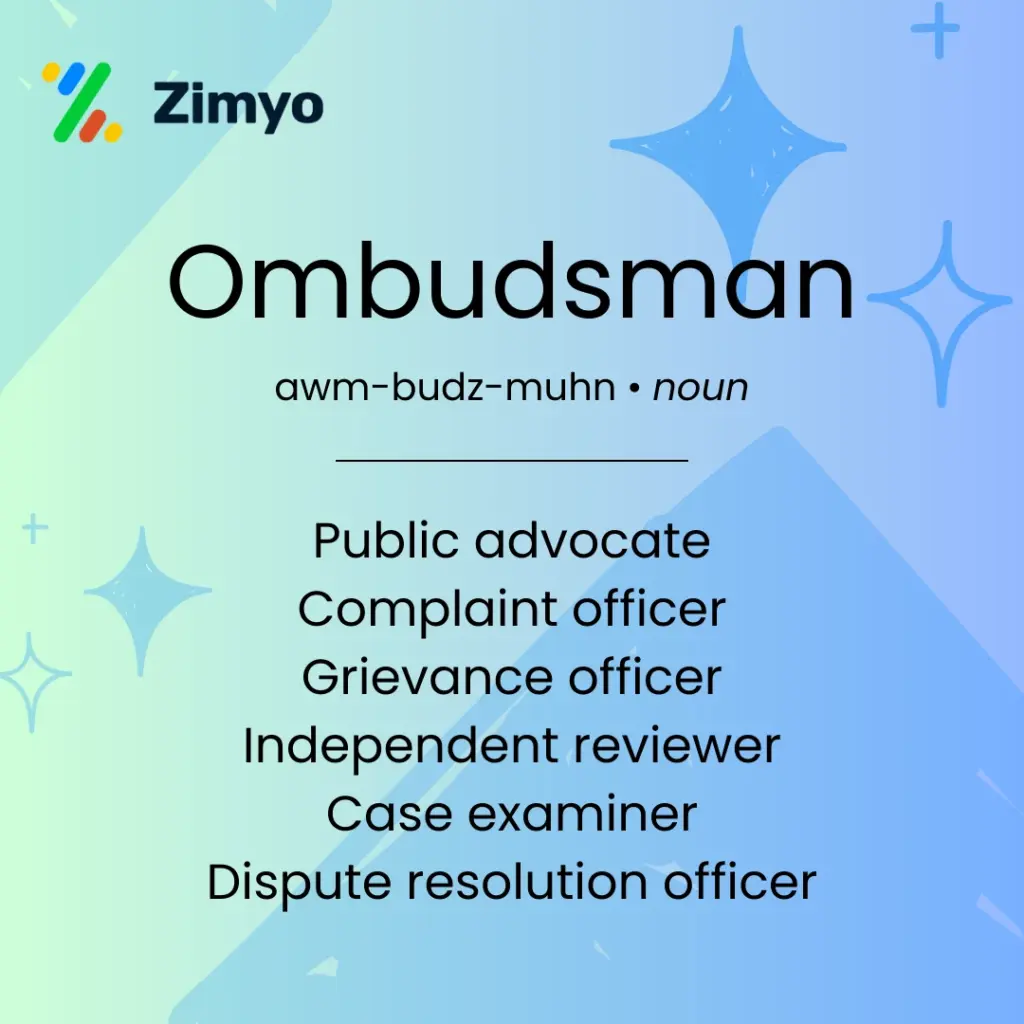
Ombudsman Synonyms
Types of Ombudsman
1. Banking Ombudsman
A banking ombudsman handles complaints related to banks, such as delayed refunds, failed transactions, incorrect charges, or poor service.
Customers can approach the banking ombudsman when the bank does not resolve their issue within a reasonable time.
What Is Banking Ombudsman?
If you are asking what is banking ombudsman, it is a free complaint-resolution system created to protect bank customers and ensure fair banking practices.
2. RBI Ombudsman
The RBI ombudsman operates under the Reserve Bank of India. It covers complaints related to banks, NBFCs, digital payments, and prepaid instruments.
People can file complaints online without hiring a lawyer, making it simple and accessible.
3. Insurance Ombudsman
An insurance ombudsman deals with disputes between policyholders and insurance companies. These may include claim rejection, delays, policy wording issues, or settlement amounts.
The insurance ombudsman helps consumers get a fair hearing without going to court.
4. Organizational Ombudsman
An organizational ombudsman works within companies, universities, or institutions. They help employees or students raise concerns safely and confidentially.
5. Public and National Ombudsman
Public ombudsmen handle complaints against government departments, public officials, or administrative bodies. Their role is to protect citizen rights and prevent misuse of power.
Ombudsman Pronunciation
The correct ombudsman pronunciation is awm-budz-muhn.
Even though the word sounds complex, the role itself is meant to be simple and people-friendly.
Benefits of an Ombudsman
- Easy and Free Access: Most ombudsman services are free. Anyone can file a complaint without legal knowledge.
- Fair and Neutral Investigation: Ombudsmen are unbiased. They listen to both sides before suggesting solutions.
- Faster Resolution: Compared to courts, ombudsmen usually resolve issues faster and with less stress.
- Builds Trust in Institutions: By holding organizations accountable, ombudsmen improve public confidence.
- Reduces Legal Conflicts: Many disputes are settled without lawsuits, saving time and money for everyone.
Limitations of an Ombudsman
While ombudsmen are helpful, they do have limits.
- Their decisions may not always be legally binding
- Complex cases can take time
- They cannot provide legal advice
- Institutions may choose how to act on recommendations
If a person is unhappy with the outcome, they can still approach courts.
Role of Ombudsman in the Workplace
In companies, an ombudsman helps employees raise concerns about harassment, discrimination, ethics, or unfair treatment without fear.
They act as a safe channel for communication and help maintain a healthy work culture
How Long Does an Ombudsman Investigation Take?
The time depends on the complexity of the complaint. Simple cases may take a few weeks, while complex matters may take longer.
Why Ombudsman Matters Today
In today’s world, institutions are large and powerful. The ombudsman acts as a balancing force, ensuring fairness, transparency, and accountability.
Whether it is banking, insurance, government, or workplaces, ombudsmen help people feel heard and protected.
Conclusion
An ombudsman plays a vital role in resolving complaints in a fair and simple way. From a banking ombudsman to an insurance ombudsman, these authorities help individuals avoid long legal battles and get justice faster.
Understanding what is an ombudsman and how to approach one empowers people to stand up for their rights with confidence.